
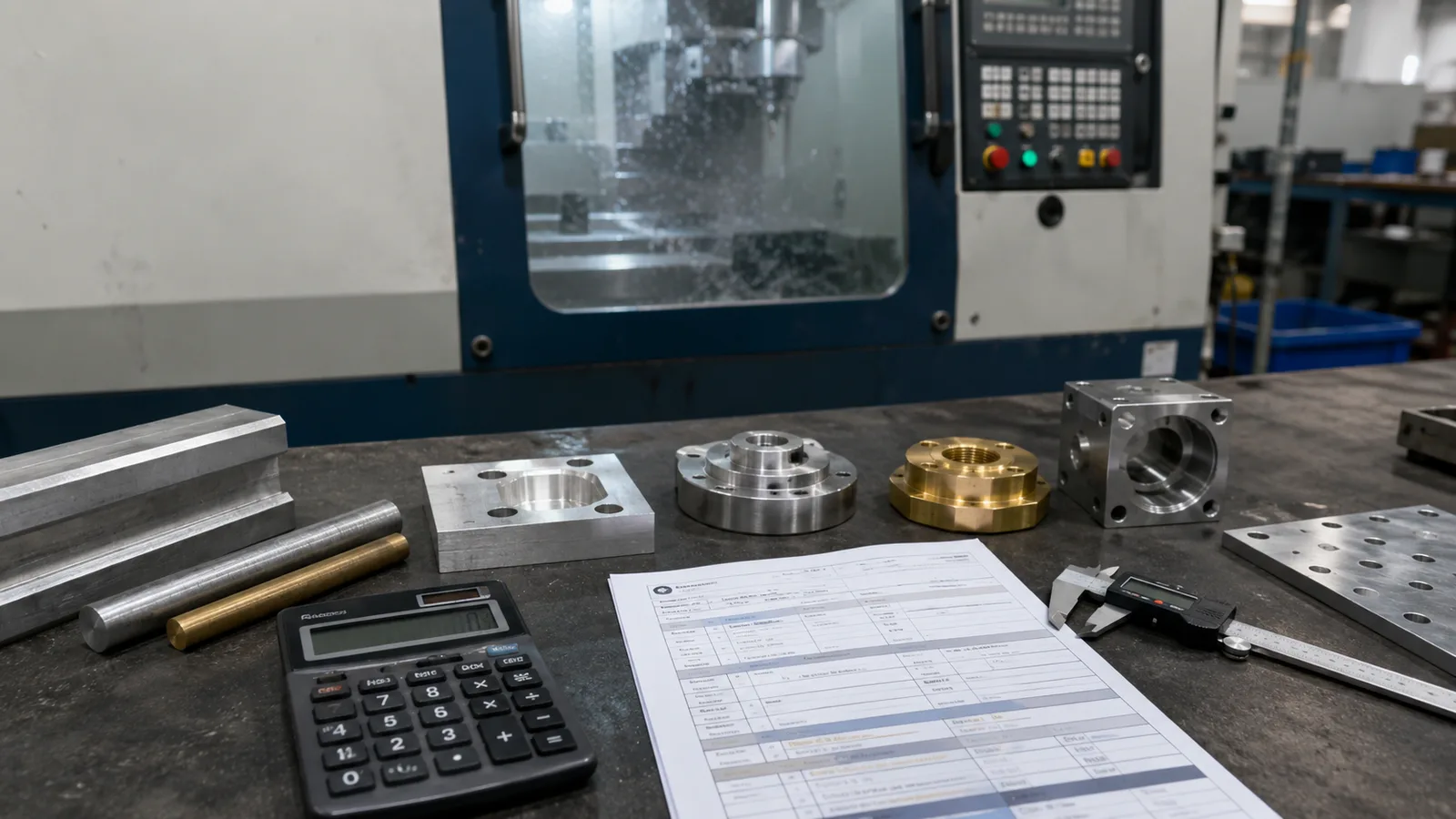
Shop rate is the wrong unit to quote from. Part geometry, setups and tolerance move far more of the final price than the hourly figure does.
What determines CNC machining cost per hour in China?
Short answer: a shop rate alone cannot predict part cost. Geometry, setup count, cycle time, material, tolerance, finish, inspection, scrap risk, and batch quantity determine the quoted unit price together.
| Cost driver | Why it changes the quote | What the buyer should send |
|---|---|---|
| Setup and geometry | More orientations, deep pockets, thin walls, or difficult access add programming and setup time. | STEP file plus a drawing that marks critical features. |
| Material | Stock price, hardness, availability, machinability, and scrap allowance differ. | Exact grade, condition, and approved alternatives. |
| Tolerance and inspection | Tighter limits can require slower cuts, controlled setups, and additional metrology. | Functional tolerances, datums, and required report scope. |
| Finish and quantity | Masking, polishing, anodizing, fixtures, and batch size change both fixed and variable cost. | Finish standard, visible surfaces, quantity, and repeat demand. |
Use the rapid prototyping cost calculator to structure early assumptions, then request a written quote for the actual CAD revision.
cnc machining cost per hour in china: buyer overview
Shop rate is the wrong unit to quote from. Part geometry, setups and tolerance move far more of the final price than the hourly figure does.
Use this guide to compare cnc machining cost per hour in china, custom cnc machining china, cnc machining china factory, online cnc machining services china in terms of manufacturability, quote readiness, supplier risk, and inspection evidence.
For DFocus, the best-fit projects are not only cheap parts. They are engineering-driven builds where the buyer needs stable communication, DFM review, documented quality control, and a clean path from prototype to low-volume manufacturing.
Cost, lead time and quote variables
Typical scope: cost estimation for CNC milling, CNC turning, setup, finishing, and inspection.
Best-fit volumes: single prototypes, low-volume batches, and repeat production orders.
Lead-time signal: fastest when CAD, 2D drawings, tolerance callouts, and finish requirements are complete.
- Geometry complexity, setup count, and whether the part needs 3-axis, 4-axis, 5-axis, turning, or secondary operations.
- Material cost, stock availability, hardness, machinability, and scrap rate.
- Tolerance, surface roughness, cosmetic finish, masking, and inspection requirements.
- Batch quantity, fixture requirements, and whether first article inspection is needed.
Material and process choices
Material choice should be tied to test requirements, not only price. If the prototype must pass mechanical, thermal, cosmetic, or assembly validation, choose the same or closest available material to the production intent.
- 6061 aluminum
- 7075 aluminum
- stainless steel
- brass
- copper
- POM
If the project is still uncertain, start with a fast prototype process, validate the design, then move to CNC machining, rapid tooling, or low-volume manufacturing once requirements are stable.
Supplier checklist before ordering
Use this checklist before sending a purchase order to any China prototype manufacturer or CNC machining supplier.
- Send STEP or native CAD files plus a 2D drawing for critical dimensions.
- Separate standard tolerances from critical-to-function tolerances.
- Specify material grade, finish, quantity, target lead time, and inspection documents.
- Ask for DFM feedback before production starts, not after parts are cut.
- Confirm whether the quote includes finishing, inspection, packing, and export shipping support.
Common sourcing risks and how to reduce them
- Unclear tolerance callouts that make suppliers quote different quality levels.
- Material substitutions without written approval or material certificate traceability.
- Cosmetic finish expectations that are not documented with color, texture, or inspection criteria.
- Shipping and customs assumptions that are not included in the quoted lead time.
The safest process is to lock scope in writing: CAD version, drawing revision, material, finish, inspection plan, packaging method, and delivery term.
Where DFocus fits
DFocus is positioned for buyers who need China-based pricing and speed, but still expect engineering review, English communication, quality documentation, and repeatable results. The related service page for this topic is CNC Machining China service.
Useful next pages:
FAQ
What files should I send for cnc machining cost per hour in china?
Send STEP or native CAD files, a 2D drawing for critical tolerances, material grade, finish, quantity, and target delivery date. Photos or reference parts are useful when cosmetic expectations matter.
Can DFocus help before the design is final?
Yes. Early DFM feedback can identify thin walls, deep pockets, tight internal radii, unsupported features, finish conflicts, and cost drivers before production starts.
How do I avoid quality problems with a China supplier?
Define acceptance criteria before ordering. Ask for material certificates, first article photos, dimensional checks, and clear communication on any drawing ambiguity.
When should I request a quote?
Request a quote once the CAD is close enough for process selection. If the design is still changing, ask for a prototype quote first and a production quote after validation.
Need an engineer-reviewed quote?
Upload CAD files or send drawings to DFocus. We will review manufacturability, process fit, material options, and quote risks before production starts.